
Among the Waves
Thoughts on treading water

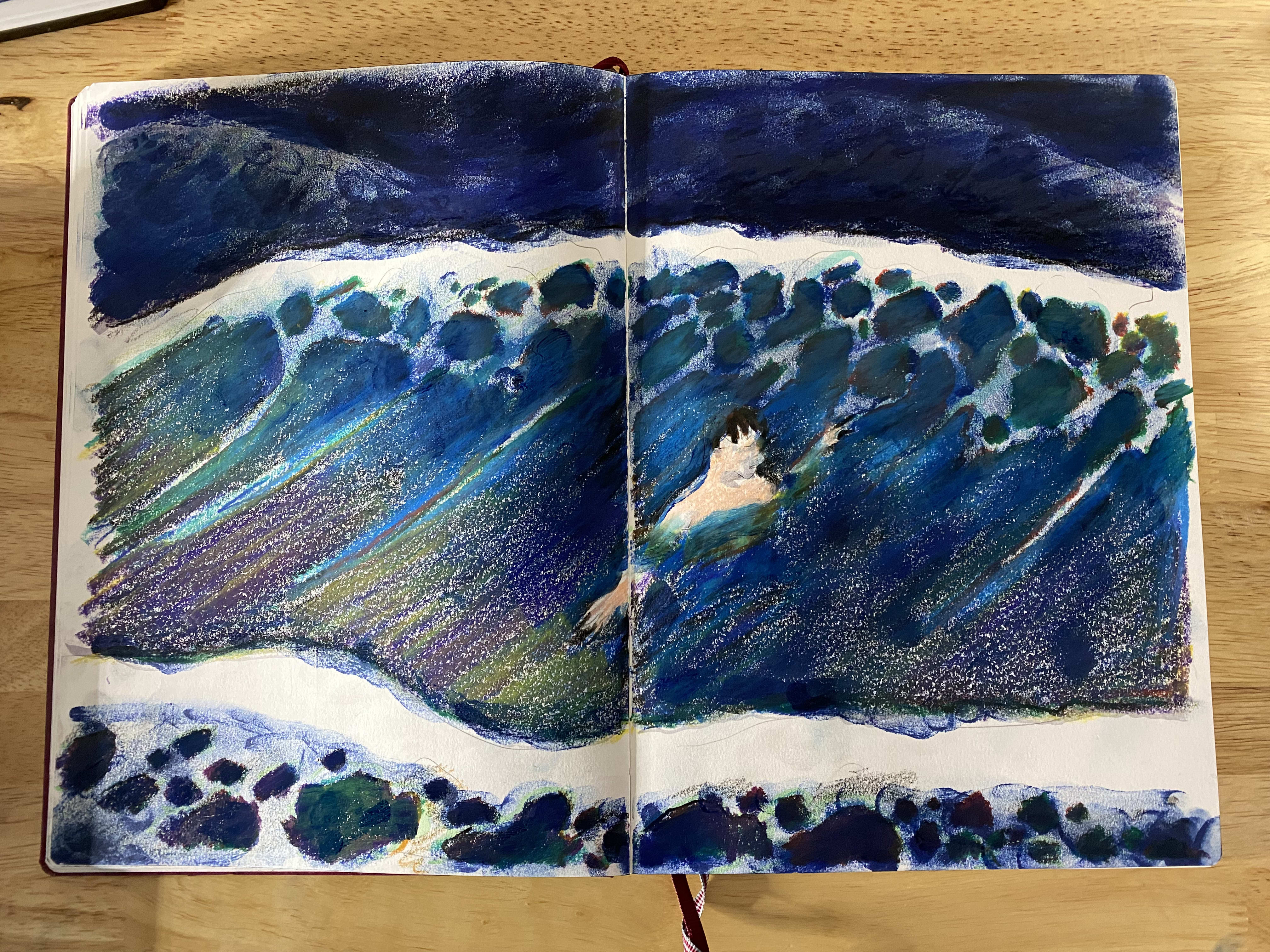
“You’re in a dark ocean…” My wife said over coffee. I had fallen over the edge of crying that I’d been teetering on for the last few weeks. The image appeared in my mind instantaneously: floating in an endlessly-open sea; the solitary buoyant being; the only thing alive within the dark and mighty waves rolling steadfast without destination, cradling me only to hand me down the line: cradle, pass, cradle, pass.
Depression is like that. When you’re in it, you lose perspective. Regardless of who or what surrounds you—a buoy, a life raft, a cruise ship, a channel marker, a lighthouse—you are unable to catch a glimpse long enough to get the message; to trust that something is there, a destination to which you are able to chart a course. You shift in the waves as you keep yourself afloat, not sure of a direction in which to swim; wondering how much energy you have to keep your head above water and unsure if anyone who sees you knows how to help. Your world view tightens until you see only your present predicament: perhaps a familiar place even in a constantly fluid ocean. “OK, I’ve been here before.”
It could be terrifying if it were foreign, but my experience is that of familiarity. Familiarity brings an unfortunate wisdom, one based on a skewed view of your situation: “OK, I’ve been here before. I know how to swim, how’d I get out this far? Why am I the only one here? I don’t like this and I don’t want to be here, but I know how to swim so I must not have been paying attention. I’m so stupid, I can’t believe I’m here again. This is on me.”
Sometimes having a creative mind has the effect of wearing a weight belt. You can visualize the ocean and make it go on forever; you can make the deafening boil of the tumult within your head; you can feel yourself in the cold, dark water; you can build waves to be impossibly tall and turn your own stomach as you tumble beneath them. It might feel like your mind is against you. At a different time you can marvel at your imagination, but here it can be an unrelenting storm, firing lightning bolts with the aim of a personal attack. It’s your mind, it can attack you and others. Be careful there.
In a threatened state, problem solving is replaced by a desperate scramble for anything that could calm the mind—regardless of the harm it might cause. What you’re looking for is something that floats. Anything that floats will give you some measurable amount of respite. The hope is that, with a calm mind, a more reasonable plan might be made to manage the situation. Of course, when you get some relief, you feel better. You might feel how tired your body is from struggling. This could influence you to think that there is no way you could make it out of this predicament alone so you might as well just hold on and see where the current takes you. This can lead to surrender, which can creep in slowly over time. Intention and decision making take energy. Survival does not necessarily depend on intention and decision making, but without those, it’s mostly down to luck. Some are washed ashore, and some swim hard to get there.
Friends are buoys. They are in their own place in the ocean and, if they’re in your field of vision, you can swim to one. However, depending on how much buoyancy they have, they may not be able to support your weight. You want the buoy to help you float because you fear that you don’t have the strength to keep moving, but you don’t want to sink anyone. Grab a hold for a bit and see if another buoy comes into view. Yes, take a break, but know that your buoys’ ability to support you largely depends on their capacity. Try not to take it personally if they are carried away out of sight. Try to remember that, whether or not it can support your weight, seeing a buoy in your vicinity is a sign of hope. It can feel like it’s not enough, because it isn’t, but it can still be a little bit. In the best case scenario, you are able to swim from buoy to buoy, gaining strength as you go, eventually getting your strength back with enough perspective to see where you’re headed. Make a note of where it is and maybe you can check in on it later. We all have our place among the waves. Knowing where the buoys are can help you navigate when your perspective gets lost and taking care of the buoys keeps them afloat so you have a better chance of counting on one in the future, should you be back here. And if you’ve ever wanted for a buoy, know that others will also be looking and maintain your own buoyancy when you can.
Family, by blood or choice, can be a boat, though not always. You might find yourself swimming up to a cruise ship in party mode and feel very out of place. You may be swimming the waters within a flotilla of frigates and other ships of war, with strict commanders on board who have no room for “losers”. There could be a Coast Guard boat out there, but maybe you also don’t want to be rescued, so you wave them off. There’s a small dingy out there somewhere, with someone at the oars who’s willing to scoot over and share the rowing duties, offering an oar—not because they’re exhausted, but to show you your own ability to get moving again. For me, that is my wife.
Lighthouses are figures resting in time. Some are better cared for, some have volunteers who help preserve their history, but there are many kept only as a pedestal for a beacon: shining out towards the water with the metronomic pulse of a ventilator. You imagine the times when the bright sunlight cast through the pane glass windows fell on the keepers in their home, as opposed to the random tables and chairs left behind, stored for some unknown use. Sometimes we look upon them with the smile in comfort of knowing, nostalgic for a time when it was people who were watching in the dark: selfless individuals who took on the role of the keeper, knowing it was their signal that others were counting on to warn of danger or welcome you home. Sometimes these outposts are a symbol of what is gone and serve only as an example of aging alone out in the weather; a symbol of those whose time has expired before we’ve found our need for their presence in our lives. Even in their absence, if we quiet ourselves, we still can see the signal through the darkness; hear the horn in the fog.
Thank you for writing this 🙏🏼
What a beautiful look at both the experience of depression and the roles others play in our experiences. It helped me see the back and forth between people in a less judgmental way (of myself when I’ve needed some boundaries with others in particular) that there’s understanding we’re all giving and receiving what we can and we all need lots of people in lots of ways to help see us through.